
Is it time to embrace the disciplined pursuit of less?
This post started life as an episode of my podcast, Unfrazzle. If you prefer, you can listen here (11m 14s)
I don’t know if you’ve noticed, but it often seems like we’re all trying to do everything.
We’re drowning in options, not just around business, but around how to human (whether that’s to do with parenting, what food we should and shouldn’t be eating, relationships, even what to watch on TV).
Things happen and change so fast. The FOMO and constant comparison are real. There are so many inputs, so much noise, it’s easy to get swept up. Trying to do all the things, and never feeling it’s enough.
When you’re buffeted around like that, you’re not making the impact you could be making because it becomes all about appearances, shoulds, and absorbing other people’s version of success.
Which means it stops being about you. Who you are. What you want. Where you shine.
When that’s how you’re living your life, what does that look like?
Well, it could be that you spend loads of time churning out content to feed the algorithm, preventing you from spending time diving deep on a subject, which would actually suit you better.
It could be that you’re running lots of small offers that have been cobbled together over time, when your biggest impact would come from going all in on something bigger. That’s what happened to a client of mine a few years ago – she doubled her income when she let go of all the small things and honed in on something bigger.
Or it could be that you’re running a business that’s doing perfectly fine, but because you’re not having consistent £10k months you think there’s something wrong and are unable to celebrate your success.
Or you’re buying all the courses, jumping on all the trends, downloading freebies, reading all the books… which doesn’t move you forward, but creates even more overwhelm.
Greg McKeown’s book “Essentialism” is the antidote to all that.
It’s for people who find themselves stretched too thin, who feel busy but not productive, and are constantly in motion but never getting anywhere.
And I love it! The philosophy of Essentialism is right up my street, so today I want to share some of the key ideas from the book that I hope will help you as you set yourself up for a great year ahead.
First of all, what is Essentialism?
It’s summarised in the book as “the relentless pursuit of less, but better”.
So instead of trying to do all the things and not doing any of them particularly well – and therefore never really reaching the heights of your potential – it’s about having a deeper dedication to fewer things.
If you’ve been to any of my workshops or guest expert sessions you may have seen me share this graphic from the book:
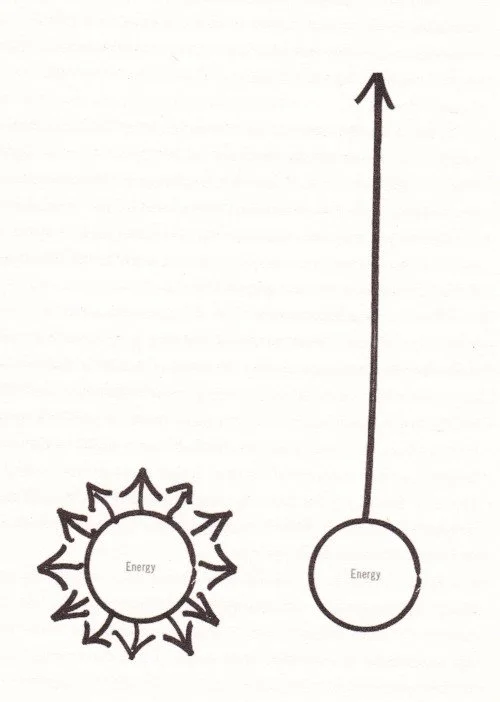
McKeown refers to the circle on the left as “the unfulfilling experience of making a milimeter of progress in a million directions.”
The circle on the right, where energy is put into just one thing, gives us “the satisfying experience of making significant progress in the things that matter most.”
It's a simple visual that always makes an impact, and beautifully demonstrates why Essentialism is so powerful.
Distinguishing the vital few from the trivial many
In order to live as an Essentialist - embracing the relentless pursuit of less, but better - we need to distinguish the vital few from the trivial many.
But how do we do that?
Well, that’s where having a strong connection to how you want your life to look and feel is important.
When you have clarity around that, it’s easier to see what is and isn’t important.
Another thing to think about is where you can make the biggest impact. Not just where can you make the biggest impact for others, but what will make the biggest impact for YOU, giving you the success you want?
What’s the best use of your time and energy?
Where do you shine?
What are the things that only you can do?
For example, if you know you’re at your best – and can make the biggest impact – on stage, how can you lean into that?
If you know you get incredible results when you meet people face to face, how do you do more of that?
If you know people respond well from experiencing what it’s like to work with you – and that feels easeful and fun for you – how do you do more of that?
The ‘vital few’ activities will look different for everyone, but when you know the highest impact activities that are in your zone of genius and that feel easeful for you, that’s when you can start to let go of the trivial many.
The main thing is to keep the main thing the main thing
I love how many great soundbites there are in Essentialism, and one of my favourites is
“The main thing is to keep the main thing the main thing.”
Isn’t that genius? In my mind, that can be applied in so many ways.
It can feed into big picture planning, where you decide what’s most important and let go of anything that might get in the way of you moving that thing forward.
And it can also be applied in smaller ways, as you’re working day-to-day.
If you need to write an email to your list, for example, for the time you’re at your computer the main thing is to keep the main thing – writing that email - the main thing until it’s done.
If you’re having a slow Sunday with your family, the main thing is to keep the main thing – meaningful time with the people you love - the main thing, so you’re not tempted to scroll on your phone, or just quickly do something else that would mean you’re not present with the people around you.
It sounds simple, but I know it isn’t always.
How do you choose between two things you want?
When I’m working with a client who has a long list of things they want to get done and I can see it’s never all going to happen in the time they want it to, it’s my job to help them figure out what’s the main thing, and what can wait.
Sometimes that’s easy. But often it isn’t.
Because making those decisions involves trade-offs. And as Greg McKeown points out, a trade-off often involves choosing between two things you want.
You want to say yes to both, but you can’t. So then what do you do?
One suggestion from the book is that instead of asking what you want to give up, ask what you want to go big on. Framing it in a more positive and expansive way can make the choice feel exciting, as you’ll start thinking about what becomes possible for you when you go all in on one, and let go of the other.
You can’t do everything. And instead of trying and then making a milimeter of progress in a million directions, it’s far better to intentionally choose what you’re willing to dedicate yourself to so you can make significant, tangible progress.
Protecting your highest priority
The final thing I want to share from Essentialism is another great soundbite:
“Our highest priority is to protect our ability to prioritise.”
For me this is everything. If you don’t protect your ability to prioritise – to distinguish the vital few from the trivial many - you can’t keep the main thing the main thing. And you’ll carry on spreading yourself too thin, feeling busy but not getting very far.
So how do you protect your ability to prioritise?
Well, let’s start by thinking about those moments when prioritising feels impossible.
In my experience, that’s when you’re exhausted, overwhelmed and frazzled. When you’re in panic mode – when your hot executive function is in charge, when the stakes feel too high, when you’re in fight or flight mode… those are the times when it becomes impossible to choose.
So in order to protect your ability to prioritise, you need to intentionally create spaces where that’s NOT how you’re moving through the world.
That looks like prioritising sleep and rest. Giving yourself space in your diary, so there’s time for your nervous system to settle between commitments. It’s about drinking enough water and eating well, so your body and brain are nourished.
And it’s also about regularly giving yourself a sense of perspective. Taking that time in the treehouse to reflect on how far you’ve come, celebrate your wins, notice the lessons.
It’s about pausing, lifting yourself up out of the weeds and getting your cool executive function on board to make good, calm decisions that are aligned with how you want your life to look and feel.
What does that look like in practice?
If your highest priority is to protect your ability to prioritise so you can keep the main thing the main thing, and make significantly more progress on the things that matter most, instead of seeing it as an afterthought that you don’t have time for, you need to prioritise the pause.
I hold space for that and guide you through a process that will allow you to take an essentialist approach to your life in Make It Happen Club.
But whether you’re in the club or not, I encourage you to consider whether the ideas I’ve shared today resonate for you. Would you like to introduce a little essentialism into your life? What might that look like for you, as we start a new year?
I highly recommend the book – it’s a great, easy read.
And as always, I hope that this helps and look forward to seeing you again soon.